Artificial Intelligence has transformed language technologies at an extraordinary pace. What was once a niche research area barely two decades ago is now embedded in our everyday lives through chatbots, translation systems, coding assistants, and AI agents. Yet, despite these advancements, one question continues to challenge researchers and technologists alike:
“Can AI truly understand language the way humans do?”
This question formed the heart of an engaging discussion at our latest Research Round Table, where researchers, founders, and AI enthusiasts explored the complexities of language agents and why human communication remains far more intricate than it appears.
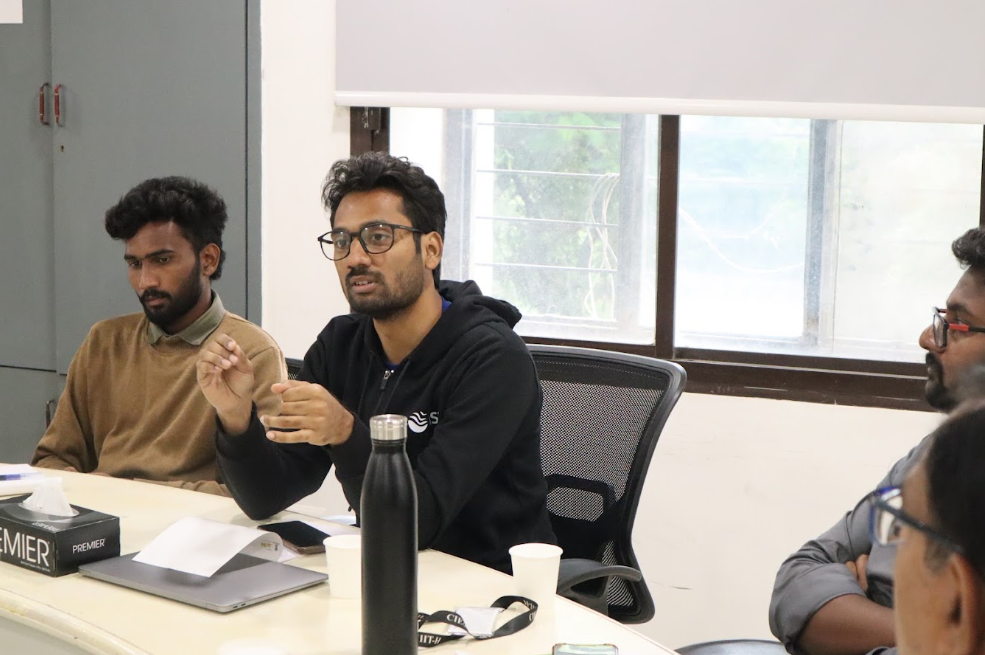
One of the earliest observations was that language cannot be separated from context. A word or phrase that feels natural in one region may carry little or no meaning elsewhere. A participant illustrated this with a simple example: while a term like khichdi curry may be familiar in some parts of the country, it may not resonate with people from the Northeast, where different vocabulary and food traditions exist. Language, therefore, is shaped not only by grammar but also by geography, culture, and lived experiences.
The conversation then shifted towards something that AI often overlooks the subtle imperfections in human communication. Unlike machines that generate fluent, uninterrupted responses, humans pause, hesitate, rethink, and change their thoughts mid-conversation. These pauses are not weaknesses; they carry emotion, intent, and authenticity. They reveal uncertainty, excitement, curiosity, and reflection, making conversations feel genuinely human. While AI can imitate language, replicating these natural rhythms remains a far more difficult challenge.
This led to a broader realization that language is not mathematics. Although it can be modeled using algorithms and probabilities, it constantly evolves with society, culture, and human interactions. New expressions emerge, meanings shift over time, and the same sentence can convey entirely different ideas depending on who says it, where it is said, and why it is said. Capturing this variability continues to be one of AI’s greatest challenges.
The conversation also touched upon society’s growing dependence on AI. From writing and coding to research and problem-solving, AI has become an integral part of daily workflows. Some even described this dependence as becoming “almost like a drug” raising important questions about how much of our thinking we are beginning to outsource to machines. This naturally extended into startup ecosystems, where investors increasingly prioritize technically strong founding teams capable of building sophisticated AI products.
An interesting perspective emerged around commercial AI systems as well. Some participants debated whether AI models occasionally appear to make unnecessary mistakes or generate longer responses leading to increased token usage indirectly benefitting usage-based pricing models.
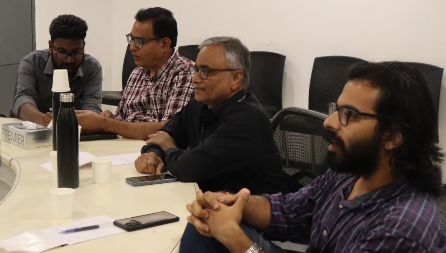
The discussion made one thing abundantly clear: the future of language agents is not merely about generating better sentences. It is about understanding people’s cultures, emotions, contexts, and intentions. As AI continues to evolve, the greatest breakthroughs may come not from building larger models, but from building systems that communicate with a deeper understanding of what it truly means to be human.
Faculty:
- Parameshwari Krishnamurthy – Assistant Professor (LTRC)
- Sourav Garg – Assistant Professor (RRC)
- Tanmay Bhowmik – Assistant Professor (CVEST)
Startups:
- Minexafe Technologies: MineXafe Technologies builds AI and IoT-based safety systems for mining and high-risk industrial sites. It focuses on real-time monitoring, compliance, and safety intelligence.
- Vygot: VYGOT is an AI layer that catches hidden reasoning errors in real time, even when the answer’s right, and fixes the exact point of confusion. An API-first “learning intelligence” layer for tutoring apps, EdTech, and LMS.
- Taramicro Technologies: Taramicro builds Edge AI-powered intelligent motion solutions for robotics, automation, and mobility.
- SiriGPT: India’s 377M Gen Z — $860B spend, heading to $2T by 2035 — overspend and under-save, and old finance apps don’t help. They need a Gen Z-first tool for real-time accountability and lasting habits.
- Dynadio: DynaDio 3D turns finger movements into real 3D shapes rendered as bubbles in a gel medium — launching as B2B ad displays for airports, hotels, and malls and expanding a desktop 3D creation tool for designers and engineers.
- Cosmic 3D: Cosmic 3D builds affordable, user-friendly 3D printers featuring IoT-based setup and AI-driven slicing technology.