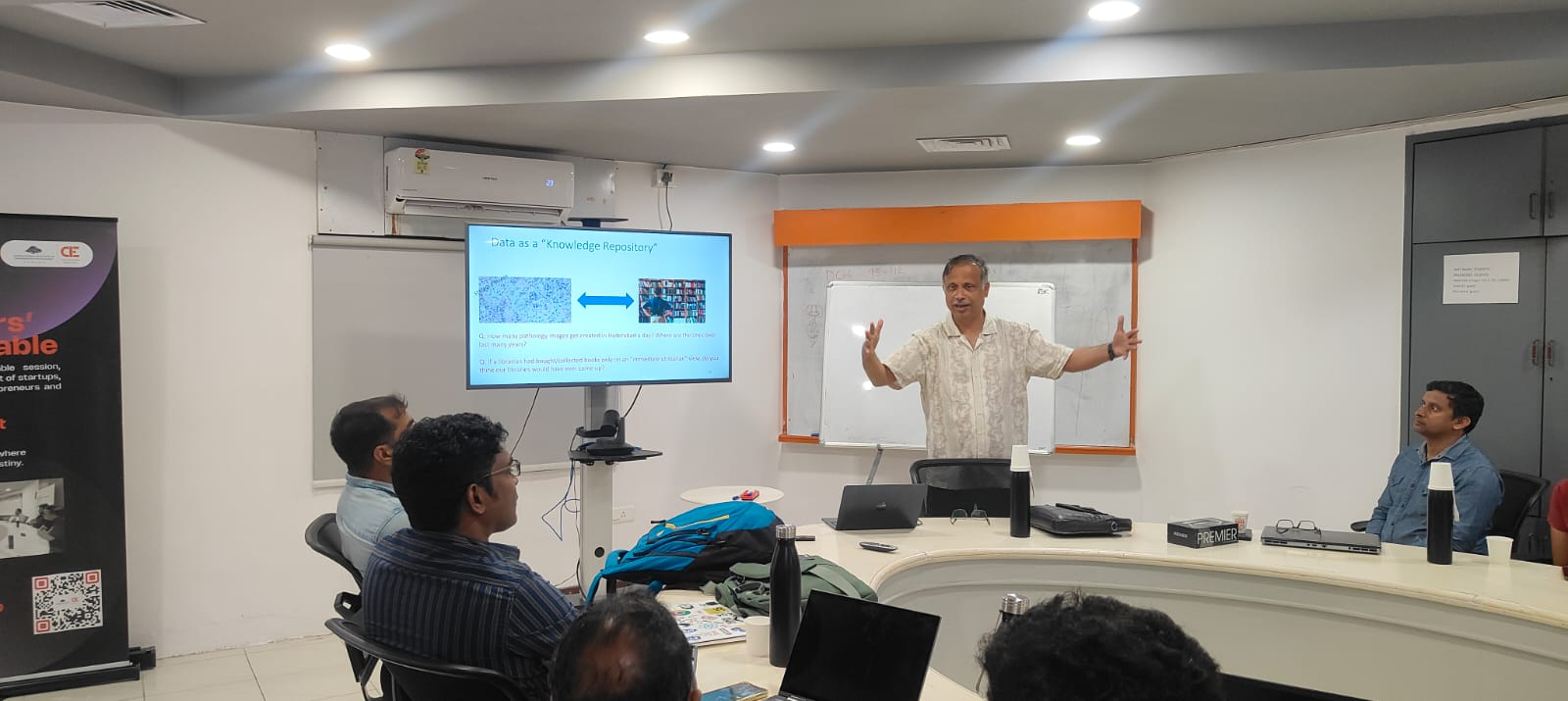
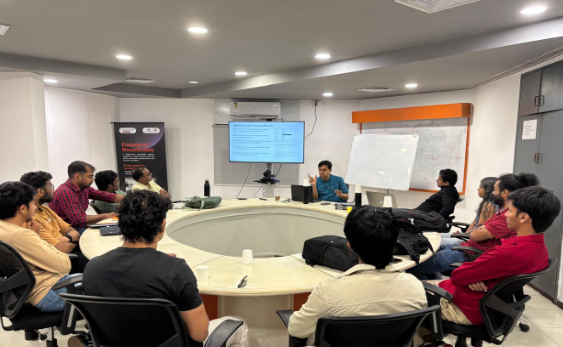
The latest edition of CV Labs focused on computer vision, bringing together emerging technologies, research expertise, and entrepreneurial innovation. The workshop offered startup founders a closer look at how computer vision systems are designed, trained, and deployed in real-world environments, highlighting the engineering challenges and opportunities involved in building reliable, scalable solutions.
The first day began by exploring how computers interpret visual information in industrial environments. Unlike consumer-facing AI applications, industrial machine vision combines specialized cameras, optics, lighting systems, and software with factory equipment, conveyor belts, and robotics. Participants discovered that successful defect detection often depends as much on the right lighting setup as on the algorithm itself. Techniques such as backlighting, dark-field illumination, and polarized lighting can reveal defects that more complex algorithms alone may struggle to identify.
The session also explored six major applications of industrial vision: surface inspection, assembly verification, dimensional measurement, barcode traceability, robot guidance, and process monitoring. Participants examined how traditional computer vision techniques, based on geometric shapes and templates, have evolved with deep learning and foundation models that can identify anomalies even when training data is limited.
The second day shifted the focus from factory-floor applications to large-scale biometric infrastructure. Using India’s Aadhaar ecosystem as a reference point, participants explored the engineering challenges involved in building identity verification systems that operate at scale, under varying field conditions and hardware constraints.
The faculty introduced the Bharat ABIS pipeline and demonstrated how specialized models such as DeepPrint for fingerprints, ArcFace for facial recognition, and dedicated iris-recognition models generate compact numerical representations, known as embeddings. These representations enable biometric systems to compare identity data efficiently. Challenges such as calibration drift, multi-camera synchronization, and changing environmental conditions can significantly affect performance. One important takeaway was that average accuracy alone does not tell the whole story; evaluating performance across different conditions and challenging data subsets is essential to understanding a system’s reliability.
The third day explored how structured datasets can help vision systems uncover meaningful patterns across medical and industrial applications. Participants learned how expert-supervised analysis can reveal cellular structures, unusual patterns, and changes across both time and space.
A major highlight was the exploration of UniAD, a framework for planning-oriented autonomous driving. Rather than relying on separate models for individual tasks, UniAD brings together capabilities such as object tracking, motion prediction, and occupancy mapping within a unified architecture designed to support safer driving decisions. The session also introduced modern approaches such as Qwen-Drive, demonstrating how vision-language models can interpret complex road scenarios and support decision -making in autonomous driving.
Following the three intensive days of in-person learning, online CV Labs sessions continued the learning journey, giving founders the opportunity to refine their technical strategies and develop their solutions further. The programme culminated in a final presentation day, where participating startups showcased their Proof of Concept (PoC) solutions with guidance and feedback from IIITH faculty and Research Assistants, founders worked towards turning complex computer vision concepts into tangible prototypes tailored to real-world challenges.
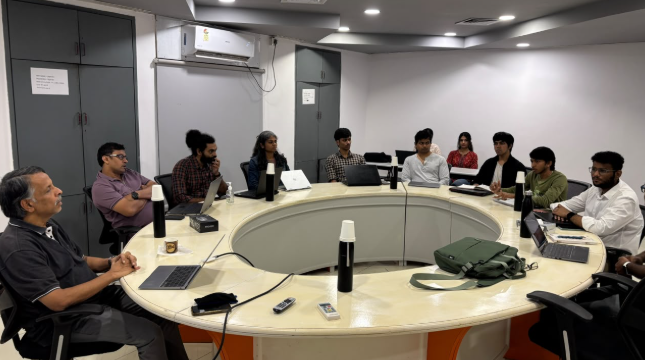
Speakers:
Faculty – Prof. C. V. Jawahar, Prof. P. J. Narayanan, and Prof. Anoop Namboodiri
RA – Himanshu, Gaurav and Devika
Startups:
Zer0n Automation – Building a connected machine-vision platform for Zero Defect Manufacturing. It inspects every product in real time, reduces false alarms and manual rechecking, and connects quality, defect, yield, and downtime data to help factories find and prevent recurring production issues.
Ethan AI – It is a real-time computer vision and audio platform that detects distress and safety behaviours in non-verbal autistic children, using ordinary cameras at homes and therapy centres.
Erudite Insight Solutions – AI-powered Vision Intelligence Platform that integrates smart cameras, autonomous drones, and advanced analytics to provide real-time detection, tracking, monitoring, and predictive insights across industrial, government, and warehouse environments.
DatumLoop Verify – It is a CAD-aware computer-vision system for electronics manufacturers, EMS providers and prototyping laboratories.
Nischay Robotics – A Shape Changing Robot which uses modular reconfigurable robotic units for all fields and tasks.
CastVision-AI – A computer-vision system that helps metal casting foundries catch surface defects automatically, right on the production line.
Mischief Inc – A robotic arm to carve sculptures.
Opsyra – Building the world’s finest inspection system for the Indian factories , transforming how modern factories see, monitor, and optimize their operations.
Independent – A CCTV alert system for workspace.
Joly AI – A startup to localise and identify different lesions on fundus camera images.